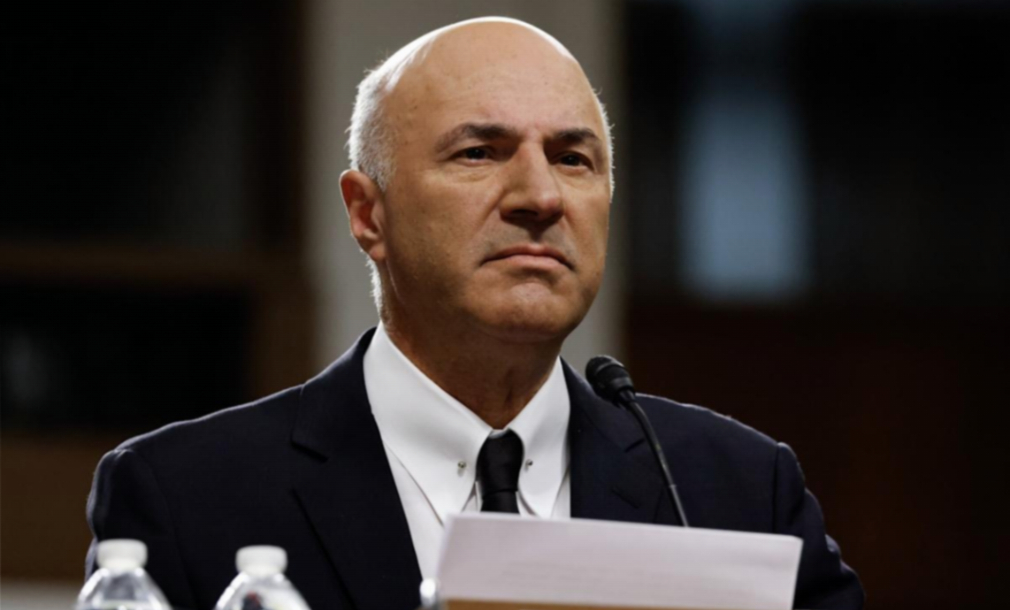
Kevin O’Leary has never been known for choosing his words carefully.
Advertisement
But his latest assessment of Canada’s escalating trade confrontation with the United States is striking even by his standards.
While businesses worry about tariffs, exporters prepare for another period of uncertainty and politicians exchange increasingly aggressive warnings, the Canadian businessman and investor is looking at exactly the same situation and seeing something completely different.
An opportunity.
And potentially, according to O’Leary, an extraordinarily profitable one.
O’Leary’s Latest Prediction Is Surprisingly Optimistic
Speaking about the latest escalation in the Canada-U.S. trade dispute, O’Leary argued that investors should stop concentrating exclusively on what is happening today.
Instead, he wants them to consider what could happen after the political confrontation ends.
He explained his thinking using a familiar hockey analogy.
“I don’t want to invest where the puck is, I want to invest where the puck is going.”
O’Leary believes the current tariff environment cannot continue indefinitely.
His reasoning is simple: the economic consequences would eventually become too painful on both sides of the border.
That has led him to a conclusion that may sound counterintuitive while the dispute is still escalating.
The turmoil could eventually create an unusually attractive moment to invest in Canada.
He Thinks the Current Situation Cannot Last
O’Leary specifically questioned whether Prime Minister Mark Carney could maintain Canada’s response to the latest American tariffs without inflicting serious damage on the domestic economy.
“Carney cannot sustain 50% tariffs on the Canadian economy,” O’Leary argued.
He also believes the pressure would be felt south of the border.
Canada and the United States have spent decades building one of the world’s most deeply integrated trading relationships. Companies routinely operate supply chains that cross the border multiple times before a finished product reaches consumers.
O’Leary therefore doubts that American states heavily dependent on Canadian trade could comfortably absorb a prolonged confrontation either.
From his perspective, that makes the current dispute politically dramatic but economically difficult to sustain.
The Numbers Explain Why This Matters
The latest Canadian trade figures illustrate the scale of the problem.
Canada’s merchandise trade surplus fell dramatically in July, dropping from C$4.2 billion in June to C$769 million.
Exports declined 2.3%, while imports increased 2.2%.
The deterioration was particularly pronounced in trade with the United States.
Canadian exports to the U.S. fell 6.6%, while imports from the country increased 1.8%.
As a result, Canada’s merchandise trade surplus with its largest trading partner fell by more than 40%.
Those numbers arrived as businesses prepared for another round of tariffs.
For many investors, that combination would normally be a reason for caution.
O’Leary sees precisely the opposite possibility.
His Argument Is About Buying During Uncertainty
O’Leary’s investment philosophy has long revolved around separating emotion from financial decisions.
That is what makes his latest argument particularly interesting.
Political confrontation creates uncertainty.
Uncertainty can reduce valuations.
And lower valuations can create opportunities for investors willing to accept risks that others are trying to avoid.
O’Leary believes the current disruption could allow investors to enter Canada near what he describes as a potential bottom.
If relations eventually normalise, he argues, investments made during the turmoil could look very different several years from now.
His prediction was characteristically bold.
He suggested the opportunity could produce a “ridiculously fantastic return over the next five years.”
It is a prediction, not a guarantee.
But it reveals how differently O’Leary views the crisis from much of Canada’s political establishment.
O’Leary Has Also Changed His Tone on Mark Carney
There is another interesting element to his recent comments.
O’Leary has spent years criticising Canadian governments and arguing that the country’s policies discouraged investment.
His relationship with Canada’s current political leadership has often been confrontational as well.
Yet in a recent conversation with Chris Cuomo, O’Leary offered a surprisingly positive assessment of Prime Minister Mark Carney.
He described Carney as “smart as hell.”
More importantly, he argued that Carney had benefited politically from standing up to Donald Trump during the increasingly difficult trade confrontation.
That does not mean O’Leary suddenly agrees with Carney’s policies.
Far from it.
But it demonstrates that his assessment of the Prime Minister is more complicated than simple political opposition.
And He Thinks Trump Has a Problem Too
O’Leary’s criticism is not confined to Ottawa.
He has also argued that Donald Trump faces a growing economic problem inside the United States.
Stock markets and large corporations can perform well while ordinary households and smaller businesses experience something very different.
Energy costs, food prices and operating expenses matter far more to those voters than headline market indices.
O’Leary believes tariffs can intensify those pressures.
That creates a political problem for Trump as well as an economic one.
In other words, O’Leary does not see the Canada-U.S. confrontation as a battle in which one country can simply keep applying pressure until the other collapses.
Both sides eventually pay.
Canada’s Economy Is Sending Mixed Signals
What makes O’Leary’s prediction more interesting is that Canada is not entering this confrontation from a straightforward economic collapse.
The Canadian economy grew at an annualised 3.3% in the second quarter of 2026, its strongest performance since 2023.
Exports increased 3.6%.
Household consumption increased.
Business investment also strengthened.
The figures confirmed that Canada had avoided the technical recession previously feared by economists.
But that recovery occurred before the full impact of the latest trade escalation could be measured.
The result is an unusual economic picture.
Canada has demonstrated resilience.
Yet it is simultaneously confronting a new external shock from its largest trading partner.
That tension is exactly what O’Leary is attempting to exploit as an investor.
He Is Betting on What Happens After the Crisis
This is the crucial distinction in O’Leary’s argument.
He is not claiming that tariffs are good for Canada.
He is not arguing that Canadian businesses will escape without damage.
And he is certainly not suggesting that the next few months will be easy.
His argument is about what comes afterwards.
If the current confrontation is temporary, then assets damaged by today’s uncertainty could eventually recover when political conditions change.
O’Leary has suggested the most intense disruption could last roughly 60 to 90 days, although there is obviously no guarantee that negotiations will follow his timetable.
That makes his position a calculated bet.
The worse the uncertainty becomes in the short term, the more interesting some Canadian opportunities could become — provided he is right that the underlying relationship eventually stabilises.
Canada and America May Have Too Much to Lose
There is a larger economic reality behind his argument.
Despite years of political disagreements, Canada and the United States remain deeply dependent on each other.
The latest figures show the U.S. still receives roughly two-thirds of Canadian merchandise exports.
Breaking that relationship quickly would be extraordinarily difficult.
Supply chains, energy infrastructure, manufacturing and investment have been constructed around cross-border trade for decades.
O’Leary is effectively betting that economics eventually overwhelms politics.
Not because the two governments suddenly become friendly.
But because continuing the confrontation becomes more expensive than ending it.
Kevin O’Leary Is Looking Beyond the Headlines
There is something characteristically O’Leary about the argument.
Where politicians see a confrontation, he sees pricing.
Where businesses see uncertainty, he looks for assets.
And where many investors see a reason to wait, O’Leary is asking whether waiting means arriving too late.
His prediction could prove wrong.
The trade dispute could last longer than he expects. Tariffs could produce deeper economic damage. Political tensions could make compromise considerably more difficult.
But O’Leary’s central point is not that the crisis is imaginary.
It is precisely the opposite.
The crisis is what creates the opportunity.
And while Canada and the United States fight over tariffs, Kevin O’Leary is already thinking about what the economic landscape could look like when that fight eventually ends.
If his assessment is correct, the most important moment for investors may not arrive after everyone knows the crisis is over.
It may be happening while everyone else is still worried about what comes next.